
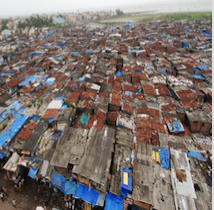
 Did you know that there exists a method called Open Building that allows affordability, happiness and health to link buildings in developing cities? You only need to look at yourself to know when you feel really happy in your living or working environment. That is when you have an influence over it, when that environment meets your need for space, light, air, comfort, meeting people and so on. With Open Building all of that is within reach. BRIQS foundation has the ambition to share this happiness worldwide, especially with the yet to be poor part.
The one billion people that, out of necessity, live in the slums of this world and want to break out now that they are slowly getting richer. Only the current approach fails miserably. That is why BRIQS foundation is looking for pioneers. Who has got the vision, the guts and the financial means to enforce a breakthrough for Open Building in these challenging areas, together with us? I gladly explain here why we need to want this badly and how we can proceed.
The desire for your own place where you can live comfortably and safely with the people you love, is universal. We all want that! Not all at once, and certainly not in the same way. But all with the desire to live as it suits us for a price you can actually afford. With Open Building we can actually fulfill that wish for the poorer part of the world. And it is absolutely crucial we do because in 2050 70% of the world’s population will live in cities, the growing prosperity is exhausting our natural resources and fossil energy severely damages our climate. So, let’s get to work!
Prefab and high-rise
The usual solutions in the fight against slums do not work. Prefabricated houses and high-rise flats are far from ideal. The prefabricated houses are often in remote places, far away from where work is available. Effective public transport is hard to organize: it is so expensive that there is little left to spend or travel times are too long or not at the right time. So the prefab areas empty out and the people that remain stay poor. People with a future once again organize their own way of living and move closer to the city.
The second solution, high-rise buildings, is not only expensive, it also creates an environment where people become isolated. There is no room for the kids to play and for people to meet. Social cohesion is lacking and crime flourishes. How do you live there if you are used to close family connections, open space, a vegetable garden and animals around you in the rural environment where you come from? With Open Building we can create a good alternative for those people in an urban environment.
Later you can download documents that the architect Frans van der Werf based on his 40+ years of housing experience shows.
Three levels of decision in Open Building
Open Building of course starts with Open Design. With this combination we have a good and lasting solution available and it is clear who decides what is being made. It is a solution divided into three levels, which reinforce each other:
- Public space (urban fabric)
- This is the level of the city on which the city council decides and an urban planner makes a design.
- The base building
- This is the level of plots on which the developer decides and the architect and his team make a plan.
- The fit-out
- This is the level of the home, the workplace, the shop on which you as a user make the decisions and for which you, a consultant or a manufacturer makes a design.
More about urban fabric
In slums the little shacks are packed along narrow alleys with an individual roof each. As humans we need more space around us, but also a certain number op people in our vicinity. The way blocks, streets, sidewalks, plazas, courtyards, sports fields, parks, school grounds, shops etc. fit together, determines how we move through the area and if we feel comfortable there. In the Open Building vision blocks have a maximum of three to four floors, a courtyard, sufficient (parking) space between the buildings and lockable alleys.
In a residential building of no more than three to four floors you are close enough to ground level to feel connected to what is happening there. And from that height you can still easily call in your children for dinner. Just like in rural settings children have room to play outside again. Youth and adults can also meet up again. That is the reason why the blocks stand around a shared courtyard. This courtyard is a very important joint space between the public and private domain where a community can develop. People know each other and take care of this affordable communal living environment together. By closing of alleys with a gate this sense of community and security increases even more.
More about the base building
The shaky structures in slums make way for open base buildings of wood or concrete. The best carriers:
- Are simple and solid for long wear and require little maintenance.
- Have galleries all around so that the interior spaces are accessible from all sides and people have contact with life all around them.
- Have a vegetable garden and solar panels on the roof.
- Are largely independent of official suppliers for energy and water, for instance.
The largest slums in the world are in countries with a tropical or subtropical climate. The ideal place to generate solar energy. Solar panels on the roof provide the residents with energy and hot water. A local energy supplier can help with financing and distribution of the energy to the neighborhood.
Most slum dwellers are from rural areas and had a vegetable garden there as their former livelihood. In the city there is no space for vegetable gardens on the ground so we make suitable roofs. The inhabitants grow fruits and vegetables for themselves and the neighborhood. Filtering and storing rainwater, installing water pumps for drinking water and compost toilets for residents make the community even more self-sufficient. All this will strengthen the community and makes it comfortable and safe to live in.
More about the fit-out
Slum dwellers are very creative in making their ‘home’ that is often far from stable. With Open Building they have a stable base building in a pleasant environment that supports their way of life. They can divide, furnish and inhabit the available space at their own discretion. And the spaces are safely stacked. What choices can we make?
To illustrate these choices, we need to go back to some Dutch examples for a minute: Keyenburg in Rotterdam, Molenvliet in Papendrecht and Meander in Zwolle. You will find detailed information about these projects in the book Open Design in the BRIQS foundation webshop. This book describes all three levels for each project; public space, base building and fit-out, and transitions between them. Looking at the fit-out residents had a choice in locating functions like living, cooking, sleeping and sanitary facilities in the open space available. Only after these choices were made did the builder place the interior dividing walls and install connections so residents could arrange for the rest of the fit-out (to be made) themselves.
Collaboration
More insight can be obtained by downloading the Frans van der Werf drawn image documents:
- the story about this on 4xA4 pages;
- the picture presentation;
- overview poster with abstract narrative and image.
 Obviously open for questions and comments!
Such projects require collaboration. Therefore BRIQS foundation is collaborating with the Netherlands Enterprise Agency (RVO.nl), CSR Netherlands and the Smart City Collective to attain the goals of Open Design and Open Building into affordable homes. Of course, we also work with innovative suppliers of sustainable construction materials and with architect Frans van der Werf in the conception of his ideas and experiences. Frans van der Werf is the author of the book Open Design.
What opportunities do you see?
So BRIQS foundation with others is focusing on this major question for some time now: How do we build sufficient affordable housing worldwide? And how do we make sure that the residents themselves keep maximum influence on the fit-out of their home and maintain in touch socially with their immediate environment. Open Building offers a wonderful opportunity here. We are looking for pioneers who want to think things through with us looking at content, process, suitable sites and possible financial resources. Sofar there has been a lot of talk on the subject worldwide but for these people not one pole is put into the ground yet. We very much want to break this impasse.
Take the next step and share your experiences
Do you want to take a next step? Come to the FREE* Masterclass. We will work with practical tools to instantly implement the actions of my ebook in your organizational, fiscal or financial projects and organization.
Join the conversation
Do you know how to build that new way and what you need? Do you see better ways to create prosperity using this separation of base building and fit-out in developing cities? Share it in the comments below.
To your health and wellbeing,
Remko Zuidema
[remko_author]
This post is also available in: Nederlands

