 Chances are you are already familiar with the term “flexible working”. But what do you know about (the) “flexible building”? Probably not as much so let me help you, because flexible building is the ultimate solution for future-proof living, working and leisure in buildings that are always ready for what you want next. I would like to explain how we can build for a future that we don’t know yet, for needs we don’t have now, with technical possibilities we have yet to discover. One thing is certain: everything is constantly changing. With flexible building that is no problem.
Do you remember these?
A house without a bathroom and a shit box in the garden, no central heating but a heater fired on coal andoil. The telex, fax, the dial telephone. And now, 230V/50Hz electricity as the standard while only some appliances in your kitchen and laundry room still need that. Imagine a future without adapters! With (USB) connections in the wall with DC (direct current) and low voltage.
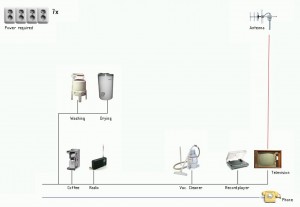
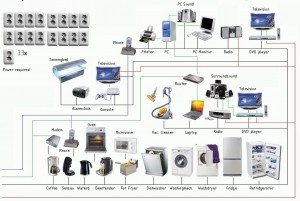
In my presentations and workshops on flexible building, I like to use two illustrations by Prof. Jos Lichtenberg of the University of Technology at Eindhoven, president of the Dutch Smart Building Foundation. Find the differences between what devices we used in the home during the sixties and what we are using now!
Can you predict what this picture will look like in ten, twenty or fifty years’ time? And what we will want from our buildings, then? I can’t! For how we live, work and enjoy leisure is not static but dynamic, innovative and unpredictable. So let’s take change as a starting point when we talk about building.
Flexible building, the premises?
The first principle, building for change, I have sufficiently explained above, I assume. Building for change can only happen if we make a distinction between the base building and the fit-out. That is the second principle. The base building, consisting of the concrete foundation, the skeleton, the utility connections and usually the facade, is the responsibility of the (social) investor. Traditionally called the building owner. As a user, you don’t need to concern yourself with that. You are the owner of the fit-out. By that I mean all facilities, decoration and furniture you need to live, work and enjoy leisure pleasurably.
Flexible building, what’s in it for you?
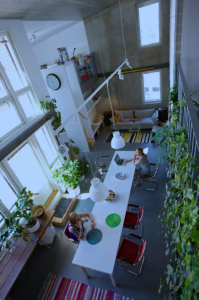 What are the benefits of flexible building for you? I’d like to put them to you one by one (even though I suspect you already know). But first I will take you along to Amsterdam and Delft, to show you two wonderful examples. The Amsterdam housing corporation Stadgenoot created the Solids. Solids are rentable units in an open base building with freedom of choice for multiple functions. The corporation built a complete core with shell (the base building) and then invited people to sign up for part of the building. The tenants then realized their own complete fit-out by themselves. The result: a strong position for the users and a wonderful creative mix of housing, business and leisure under one roof.
Five years ago the DOK Delft Library Concept was completed. How special, inviting and user friendly, the facilities have become, you can see on YouTube or on site. See more on the specific blog about it. There is no way the base building experts would have come up with this range of possibilities. That is why the actual users were closely involved with the facilities and the interior design.
The advantages of flexible building at a glance
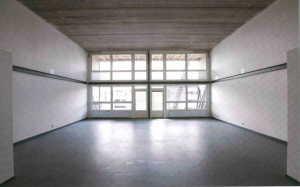 Flexible building emphatically starts from looking at the base building and fit-out separately. See for a amazing example finished in 2011 in Helsinki. Only then you can respond flexibly to changing needs and new opportunities. The investor is responsible for the base building. And you, as a user, are responsible and empowered for the fit-out. In Japan this (housing) approach is already a huge success. They assume that a base building should at least be usable for 200 years. So how do you benefit from al this?
1. You have maximum freedom to organize and adapt your home and/or workplace. You determine where the separating walls, the kitchen and the bathroom are placed. You choose fit-out related MEP systems (Mechanical, Electrical, Plumbing) that meet your needs for water, heating and ventilation. And that is still possible when construction has already begun or in an older, existing building.
2. The separation provides us with new, beneficial economic, legal and tax possibilities. You could close a mortgage on the fit-out where now only an ordinary loan is possible. And as the owner of the fit-out you can move the fit-out and mortgage to a new home.
3. There are new providers entering the market. Producers that directly deliver a complete fit-out of your choice. You can either buy that fit-out or lease it for a nice monthly fee. In that way you pay for the use rather than for the ownership. Comparatively, why buy lamps if you only need light?
4. With the separation of base building and fit-out we finally achieve truly sustainable building. In such a modern building we mix or glue no materials and we certainly do not put MEP systems in concrete. All parts are separately replaceable when their life cycle is complete. We move from consuming to using and reusing. We regain valuable (biological) materials where we can.
Then providers finally have a real interest in only delivering high-quality products, because it determines their future success. And that is a big advantage for you as a user!
How do we get to flexible building!
Some things are already possible, but parts of the current rules and regulations interfere with this transformation. That has got to change. I see to your interest in several ways.
1. By giving you the knowledge and tools to influence the building industry so you get what you want and need. Through my blogs, articles with facts & figures, webinars, workshops, presentations and consultations. Please let me know what you need.
2. By influencing the building industry from within. Among other things by making maximum use of the possibilities within current rules and regulations. And by exploring new legal and financial possibilities we additionally need.
3. By representing your interests with officials and politicians in The Hague. I have been discussing the problems and opportunities with government officials since 2011. They are expected to present proposals in the Dutch House of Represenatives – in response to adapted motions by them earlier – that will strengthen the position of users in buildings. I am most happy to help them with that.
Take the next step and share your experiences
Do you want to take a next step? Come to the FREE* Masterclass. We will work with practical tools to instantly implement the actions of my ebook in your organizational, fiscal or financial projects and organization.
Join the conversation
Do you know how to build that new way and what you need? Share it in the comments below.
To your health and wellbeing,
Remko Zuidema
[remko_author]
This post is also available in: Nederlands

